


Advantages
➢ Conventional surgery for nonunion has been performed by exposing and resecting the lesion, followed by fresh autologous bone grafting. This technique enables nonunion to be treated in a more minimally invasive manner than conventional methods.
Current Stage and Key Data
PoC stage based on non-clinical research and animal testing
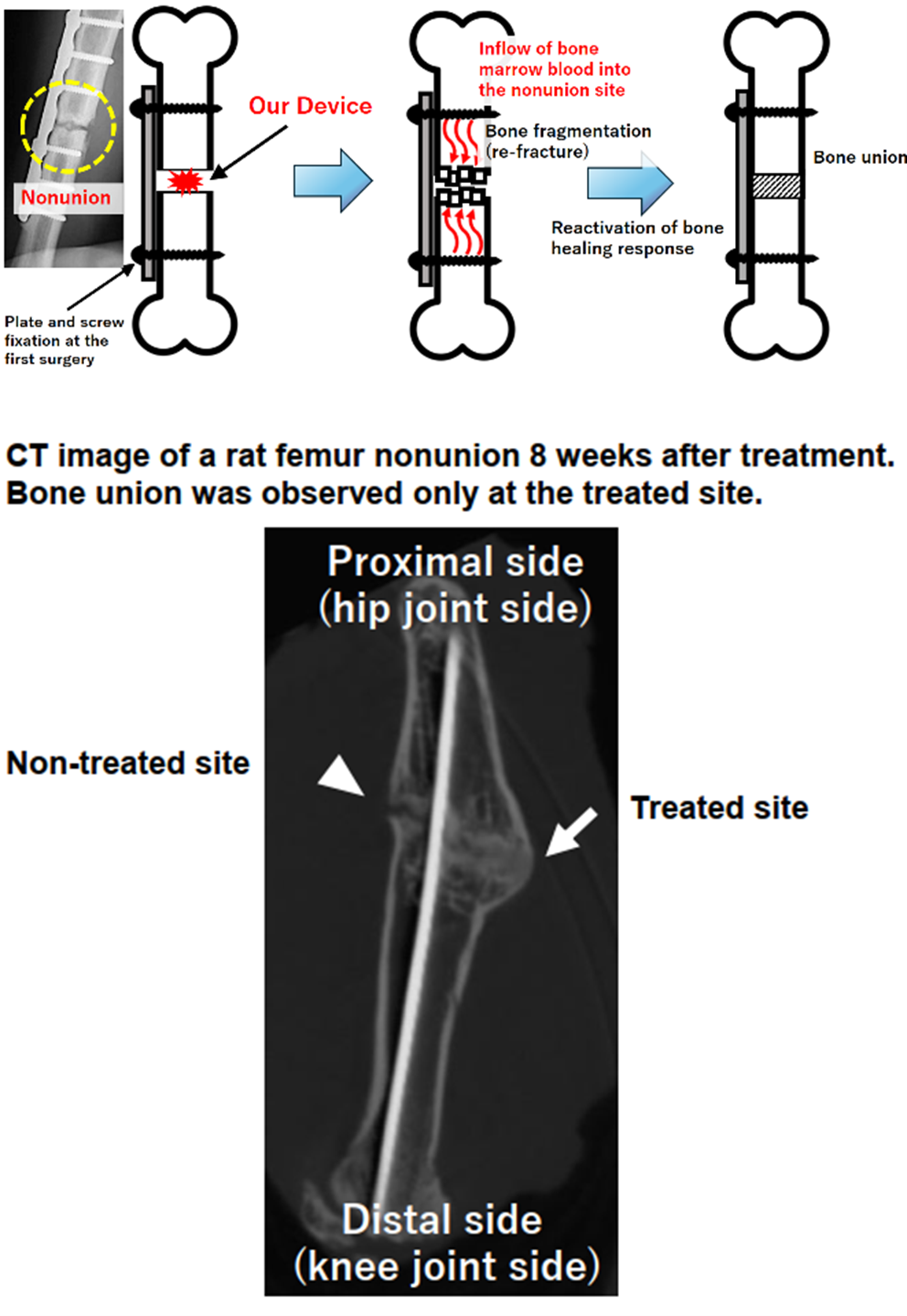
➢ Efficacy confirmed in rat femoral nonunion model using prototype device.
 |
Partnering Model
Seeking partners for the commercialization and development of this device. Patent licenses and joint research are available.
➢ Example of a potential partners: medical device companies specializing in minimally invasive therapy or in the orthopedic field.
Background
In the surgical treatment of nonunion, it is common practice to fix the fracture with plates or screws, resect the nonunion site, and graft autologous bone into the defect. However, resection of the nonunion requires surgical exposure of the lesion, and harvesting autologous bone necessitates an additional incision at a healthy site, making the procedure complex and highly invasive. As an alternative, extracorporeal shock wave therapy has been experimentally applied to induce microfractures at the nonunion site and stimulate a healing response, but its efficacy remains limited.
This device is a novel medical device for the surgical treatment of nonunion, enabling bone union to be achieved with less invasiveness than conventional techniques.
Principal Investigator
Masaomi Saeki (Department of Advanced Medicine, Nagoya University Hospital /Department of Human Enhancement & Hand Surgery, Nagoya University Graduate School of Medicine, Tokai National Higher Education and Research System)
Reference
➢ Unpublished.
➢ Patent pending.
Project No. BK-05242