


Advantages
- A novel technology that dramatically enhances MRI/NMR sensitivity by highly efficiently polarizing nuclear spins.
- Achieves 10,000 times higher sensitivity than conventional NMR at room temperature and low magnetic fields.
- Enables ultra-high-sensitivity chemical analysis and in vivo metabolic imaging.
- Applications: Low-concentration molecular screening in drug discovery, detection of hard-to-detect cancers (ultra-early stage, deep-seated), early visualization of cancer treatment efficacy
- To MRI/NMR equipment manufacturers, medical device/scientific instrument manufacturers, and pharmaceutical companies: We invite you to consider participating in our development project.
Background and Technology
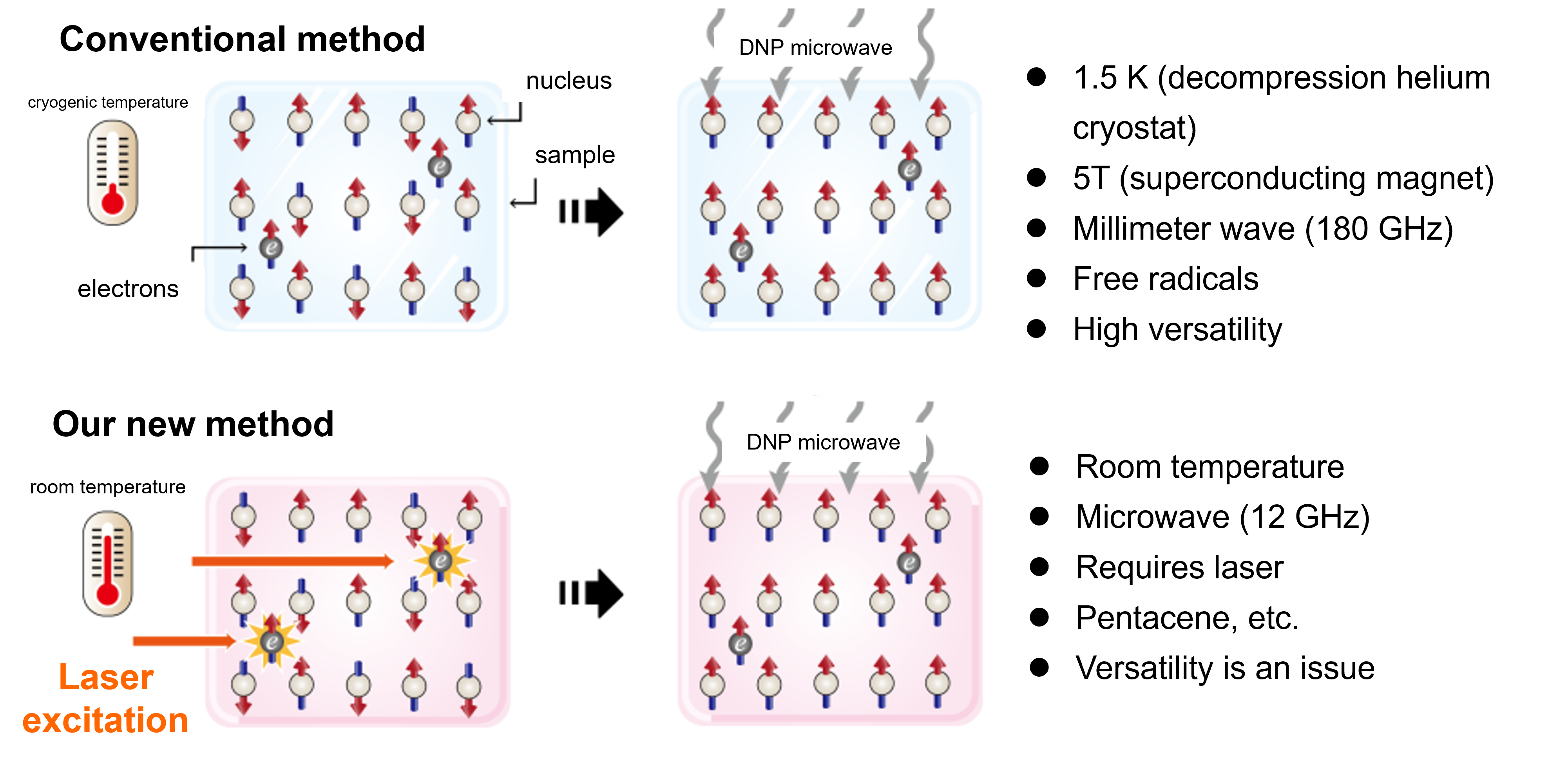
MRI and NMR are technologies capable of non-invasively visualizing the structure and metabolism of living organisms and compounds. However, their sensitivity is limited by the low natural polarizability of nuclear spins. Consequently, real-time tracking of minute metabolic changes within living organisms and precise analysis of trace samples have been challenging. Dynamic Nuclear Polarization (DNP) technology was developed to address this challenge. However, achieving high nuclear spin polarization required cryogenic temperatures (1.5 K) and extremely strong magnetic fields (5 T), resulting in large-scale, expensive equipment. Furthermore, the polarization lifetime achieved by DNP technology was short, lasting only about one minute, limiting its applications.
Professor Makoto Negoro and colleagues at the University of Osaka developed a new technique, the “Triplet DNP Method,” to overcome these challenges. This method uses laser-excited pentacene molecules in the triplet state as a polarization source. It combines microwave irradiation with magnetic field sweeping to polarize nuclear spins. This technology enables highly efficient polarization, resulting in signal intensities 10,000 times stronger than conventional NMR. Furthermore, it offers significant practical advantages: a long polarization lifetime (over 10 minutes), operation at room temperature, and low magnetic fields (0.4 T electromagnet).
This technology enables ultra-high-sensitivity chemical analysis and metabolic imaging. It promises unprecedented insights in drug discovery and clinical applications, such as low-concentration molecular screening in drug development, detecting deep-seated or ultra-early-stage cancers, and early visualization of cancer treatment efficacy. Furthermore, the device is low-cost, energy-efficient, and compact (fitting within 1.2 m³), allowing direct installation into existing MRI rooms.
 |
Current Stage and Key Data
We developed a polarization device operating at room temperature using a 0.4-tesla electromagnet. A single crystal of p-terphenyl was subjected to this device and highly polarized via the triplet DNP method. The microwave and magnetic field emitted by this device caused trace amounts of pentacene doped into the crystal to transition to the electron spin triplet state, subsequently polarizing the nuclear spins of the p-terphenyl. This polarization rate was exceptionally high at 34%, resulting in a signal intensity 10,000 times stronger than conventional NMR spectroscopy (10 Tesla, room temperature).
Development is underway to apply this technology in vivo. In addition to developing techniques to dissolve the highly polarized probe molecules for administration, successful MRI signal detection in mice has been achieved.
Partnering Model
The University of Osaka is advancing a technology development project based on this technology. We would greatly appreciate the participation of MRI and NMR equipment manufacturers, medical device manufacturers, and scientific instrument manufacturers.
We also welcome inquiries regarding its application from pharmaceutical companies and pharmaceutical-related enterprises. This technology offers a novel, non-radioactive, highly sensitive, and rapid screening method for pharmacokinetics and target molecule discovery. It contributes to early pipeline evaluation and streamlines pre-toxicity testing selection.
We invite you to understand the project through meetings with researchers and discuss participation. Please feel free to contact us.
Patents
Patent No. 6789585 (in Japan) and others in US and/or EP.
Principal Investigator
Associate Professor Makoto Negoro (Center for Quantum Information and Quantum Biology, The University of Osaka) and, et al.
Project ID:DA-02207a