


Advantage and Core Benefit
- Versatile application to multiple genotypes, including worldly spread GII.4 and GII.17
- Capable of producing noroviruses with arbitrary mutations, deletions, or foreign genes, such as reporter genes insertion
- The “direct DNA introduction method,” eliminates the need for cell culture, simplifies the manufacturing process and significantly reduces costs and lead times
Background and Technology
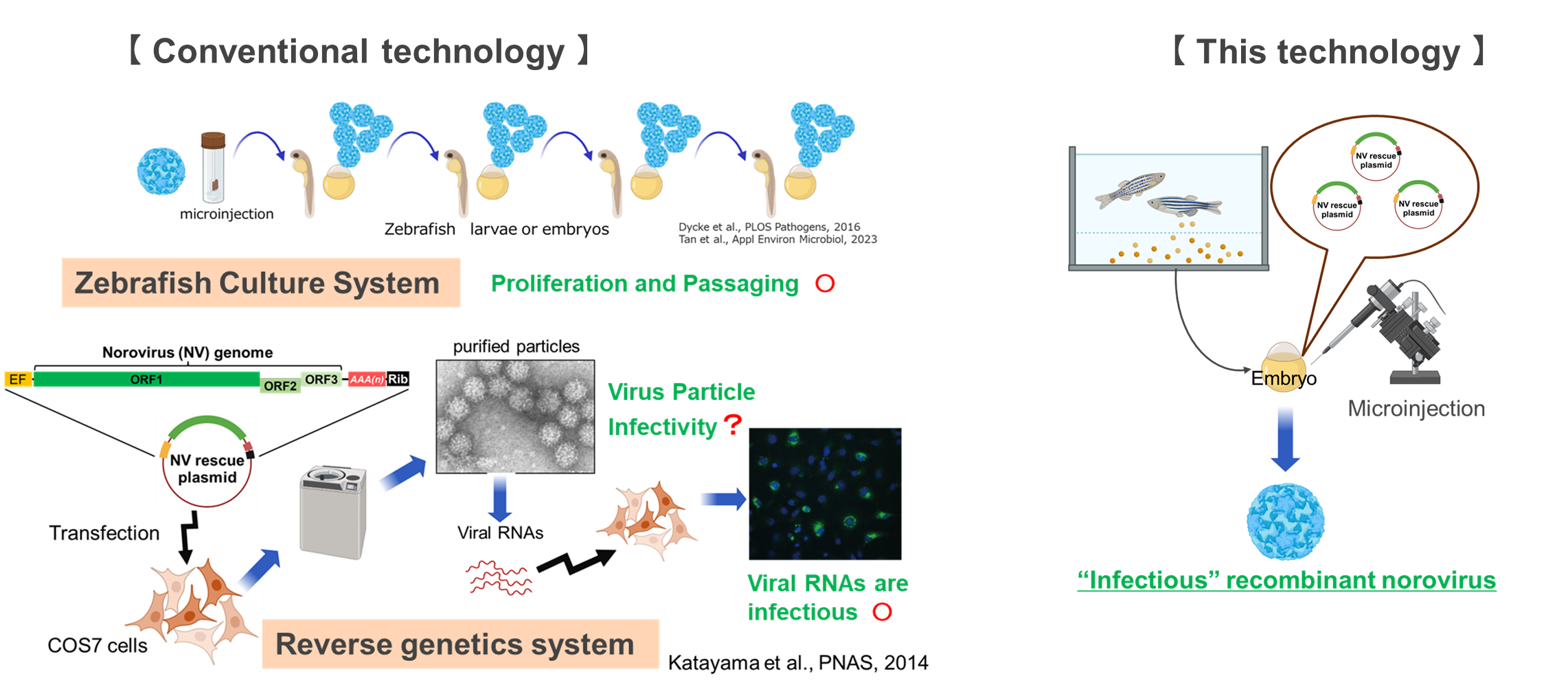
Norovirus is a major infectious disease affecting 680 million people worldwide annually, yet developing vaccines and therapeutics is extremely challenging. The main reason for this is that human norovirus (HuNoV) does not grow in standard cell cultures. Currently, HuNoV growth systems using intestinal organoids are the mainstream of research, but this method suffers from low virus growth efficiency and the difficulty of stable long-term subculture. Additionally, research using reverse genetics (RG) technology, an essential tool for virus research, has been reported, but the particles produced have not been confirmed to be infectious, and due to its limited practicality, it is not widely used.
This technology combines the existing RG cell culture system with a zebrafish propagation system capable of serially culturing HuNoVs. By directly introducing a genomic cDNA plasmid into zebrafish embryos, the world’s first reverse genetics technology has been achieved. It is compatible with multiple genotypes, including GII.17 and GII.4, and allows for the introduction of specific nucleic acid site mutations and reporter genes while maintaining growth rates equivalent to those of the wild type. This enables a simple and stable supply of HuNoVs without relying on unstable natural strains or expensive organoid cultures, potentially fundamentally accelerating norovirus research and development, such as the selection of attenuated vaccine candidate strains and the establishment of antiviral drug evaluation systems.
 |
Data
- Direct microinjection of HuNoV genome cDNA plasmids into zebrafish embryos/larvae produced and propagated infectious recombinant HuNoVs (GII.17, rGII.17, rGII.4).
- The recombinant HuNoVs were serially passaged (inoculated) into zebrafish embryos/larvae three times. They amplified by more than three orders of magnitude each time and maintained high proliferation comparable to that of the wild-type (WT).
- EcoRI recognition sequence mutations or a sequence encoding a HiBiT tag (11 amino acids) as a reporter were inserted into specific regions of the HuNoV genome, and they were still stably amplified and passaged while maintaining proliferation and infectivity.
Current Stage and Next Steps
- Basic technologies for generating and stably passage infectious recombinant HuNoVs and introducing reporter genes have been established.
- We are currently designing attenuated strains for vaccine development and conducting applied research (early preclinical stage) in animal infection models such as mice and marmosets.
Patent & Publication
- Patent pending by Osaka University (unpublished)
- Press Release: https://www.biken.osaka-u.ac.jp/en/achievement/research/2025/251
- Article: DOI:10.1073/pnas.2526726122
Researcher
Takeshi Kobayashi, Ph.D. Professor, Research Institute for Microbial Diseases, The University of Osaka
Expectations
The University of Osaka is seeking pharmaceutical companies and CROs engaged in vaccine development or antiviral drug development who are interested in this technology.
We offer manufacturing method licensing (for internal use or contract services), virus production services at the university (under an MTA), and variant strain creation (through collaborative research).
Meetings with researchers can also be arranged.
Project ID:KJ-05252